


















Since 6 April 2025, UK consumer law has contained a specific ban on fake reviews, hidden incentives and misleading ways of showing reviews. It applies to any restaurant, hotel, bar or café that asks for reviews or shows its ratings, not just to the review sites. This guide covers what the rules say, what the Competition and Markets Authority (CMA) can do, and where to start this week.
What changed on 6 April 2025
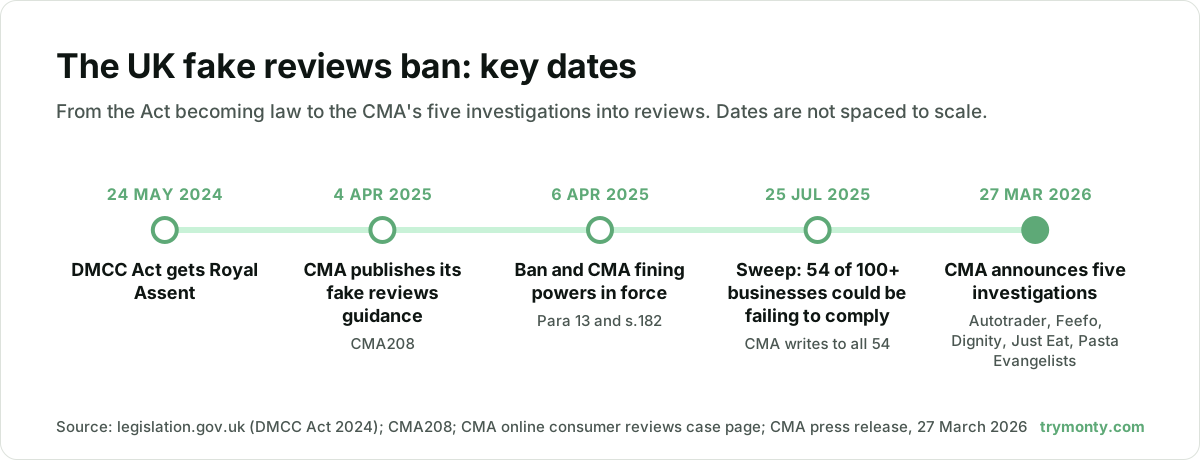
Schedule 20 of the Digital Markets, Competition and Consumers Act 2024 (DMCC Act) lists practices that are banned outright. Paragraph 13, which deals with reviews, came into force on 6 April 2025. The CMA's fake reviews guidance (CMA208) describes these banned practices as behaviour that is "automatically unfair and illegal".
Paragraph 13 bans four things:
- submitting, or commissioning someone else to submit or write, a fake review or a review that hides the fact it was incentivised
- publishing reviews, or information drawn from them such as star ratings, in a misleading way
- publishing reviews or ratings without taking reasonable and proportionate steps to prevent and remove fake or concealed incentivised reviews and false or misleading review information
- offering businesses a service that does, or helps with, any of the first two
From the same date, the CMA can decide for itself whether consumer law has been broken and fine businesses directly, without going to court.
What counts as a fake or concealed incentivised review
The Act defines a fake review as one that "purports to be, but is not, based on a person's genuine experience". The CMA's guidance adds that a star rating on its own counts as a review, that the ban covers fake negative and offline reviews too, and that a review is not fake just because you disagree with it (paras 2.2 to 2.8).
Under the Act, "commissioning" a review "includes incentivising by any means". The CMA's examples include discounts or vouchers, freebies and free stays, and asking a member of staff to write a review can count (para 2.10). Our guide to incentives for reviews also covers prize draws and staff bonuses.
Incentivised reviews are not unlawful in themselves, but the incentive must be disclosed and the review must be genuine (para 3.7). Where a site bans them, the CMA says submitting one is likely to be misleading (para 3.4). As of September 2026, Google's Maps content policy bars businesses from offering payment, discounts or freebies for a review, or for changing or removing a negative one. So a free dessert for a Google review breaks Google's rules and is likely to be misleading under UK law too.
Asking is fine. Encouraging reviews "by merely emailing customers generally to ask if they wish to provide a review" is not prohibited (para 3.6). Our guide to getting more Google reviews covers the review link, what to say and what to avoid.
| Situation | Where it stands |
|---|---|
| Asking every guest for a review | Allowed (para 3.6) |
| A free drink or discount in return for a review | Commissioning. Must be disclosed and genuine under UK law, and Google does not allow it |
| Asking staff to review the venue they work for | Can be commissioning, and hiding the link may be misleading (paras 2.10 and 4.6). Google removes employee reviews as a conflict of interest |
| Offering a refund or gift card if a guest changes a negative review | A CMA example of commissioning (CMA208, examples after para 3.5) |
| A website widget that only shows 4- and 5-star reviews | Likely to be publishing reviews in a misleading way (paragraph 13(5)(i)) |
Hiding or cherry-picking reviews is now a banned practice
The Act gives examples of what publishing reviews "in a misleading way" includes:
failing to publish, or removing from publication, negative consumer reviews whilst publishing positive ones (or vice versa); giving greater prominence to positive consumer reviews over negative ones (or vice versa)
DMCC Act 2024, Schedule 20, paragraph 13(5)(i)
The CMA says cherry-picking can happen before a review is written, "by encouraging just those who are satisfied to leave reviews" (para 4.5). Businesses should not deter negative reviews either, for example "by arbitrarily stopping and starting review invitations" (para 4.4). Google's policy points the same way: businesses must not discourage negative reviews or ask only happy customers for them. Inviting only happy guests is often called review gating.
For venues, that rules out some common habits:
- asking only the tables that seemed happy, or pulling the QR cards after a bad night (paras 4.4 and 4.5)
- a goodwill gesture offered on condition the guest does not post (para 4.4)
- persuading unhappy guests to complain privately instead of posting a review, or putting them off posting once the problem is fixed (para 8.11)
If you show reviews on your website, you're a "publisher"
Paragraph 13(3) puts a duty on anyone who publishes reviews, and the CMA says that covers businesses that repeat ratings from elsewhere. Its "second-party publisher" includes "a trader who displays on its own website ratings for its business given on a first-party publisher's site" (para 8.32(b)).
So a Google rating badge on your booking page, a Tripadvisor widget or review quotes in a brochure all bring you into scope, because the Act covers publishing "by any means" (paragraph 13(5)(h)).
A venue that only shows its Google rating may need lighter steps than a review platform, depending on its own risk assessment, but it cannot hand the duty over (para 8.32(b)). You can rely on the platform's checks only if you have read its policies and have reasonable grounds to think they meet the duty (para 8.32(b)(ii)). Size is no excuse either: even a small trader publishing only its own customers' reviews must take reasonable and proportionate steps where its content poses a risk (para 8.31).
The CMA's short guide for businesses sets out the basics:
- a published policy that clearly bans fake reviews and states your approach to incentivised reviews and ratings, easy to find and in plain English (CMA208 para 8.10)
- a regular assessment of the risk of banned content in anything you control, since it is "not a one-off exercise"
- processes to detect, investigate and act on banned reviews
Penalties and what the CMA is investigating
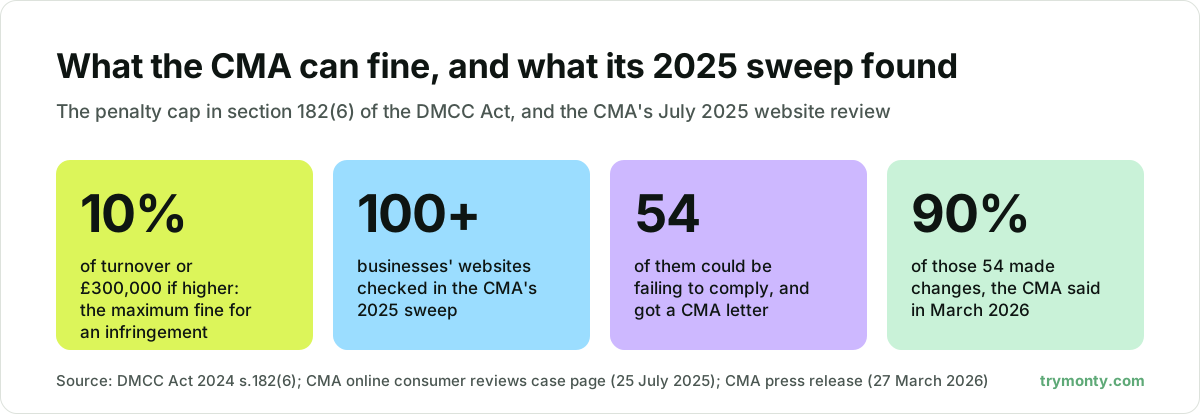
If the CMA finds an infringement, section 182 lets it give directions, require a corrective statement and impose a fine of up to "£300,000 or, if higher, 10% of the total value of the turnover" of the business.
Breaching paragraph 13 is not in itself a criminal offence: section 237(8)(b) excludes it from the Schedule 20 offence, and the CMA enforces it with civil powers. The same conduct could still be a misleading action or omission under sections 226 or 227, which can be offences under section 237(1) and (2), or fraud under the Fraud Act 2006 (CMA208 para 1.4 and footnote 4).
What the CMA has done so far:
- Website sweep. The CMA reviewed the websites of more than 100 businesses and found that 54 could be failing to comply (online consumer reviews case page). Some had no policy banning fake reviews; others had one that was unclear, incomplete or hard to find. The CMA wrote to all 54 and later said 90% had made changes.
- Five investigations. On 27 March 2026 the CMA announced investigations into Autotrader and Feefo (handling of 1-star reviews), Dignity (whether staff were asked to write positive reviews), Just Eat (whether its ratings system inflated some restaurants' ratings) and Pasta Evangelists (whether customers got undisclosed discounts for 5-star reviews). The CMA said "it has not reached any conclusions about whether consumer law has been broken".
As of 25 September 2026, all five case pages (Autotrader, Feefo, Dignity, Just Eat, Pasta Evangelists) list the case as open with no finding made. Each gives September 2026 for the next update, so check them for the latest.
A compliance checklist for venues
- List everywhere you show reviews or ratings. Website, booking engine, menus, brochures, social posts.
- Check for filters. If a widget hides low ratings or shows only hand-picked quotes, switch to the full feed or show the overall rating with a link to the source. Keep any quoted rating current and sourced.
- Publish a short reviews policy. Say you don't write, buy or incentivise reviews, explain how you display ratings, and give a contact for reporting a suspect review. Link it from your footer.
- Brief your team in writing. No reviews of your own venue or competitors, no freebies or discounts for reviews, and no refunds or gestures for changing or removing one.
- Ask every guest the same way. Same card, same wording, every service, including after a bad night. Don't pressure guests to review at the table, and don't set staff review quotas, which Google does not allow.
- Keep complaints and reviews separate. Fix problems without conditions, and never ask a guest not to post. Our guide to in-stay feedback for hotels shows how to do both.
- Check your suppliers. Ask any marketing or SEO agency, in writing, how it gets reviews. Offering to obtain fake or concealed incentivised reviews for a business is itself banned (paragraph 13(4)).
- Write it down and diary a repeat. Note what you checked and which platform policies you read. Repeat every few months.
Where Monty fits
Monty asks every guest for feedback through a branded page opened from a QR code on table cards, stands or room cards. A low rating or an issue report becomes an SOS alert for the right person by email, WhatsApp, Telegram or in the app.
The review inbox drafts a reply to each Google, Tripadvisor and Trustpilot review for a person to check and post. The policy, team briefing and checks above are still yours to run.
This article is general information, not legal advice.

The team behind Monty, proactive reputation management for restaurants, hotels, bars and cafés.
How we write our articles