

































Your reply to a negative review is read by future guests, not just the person who wrote it, so it matters as much as the review itself. This guide covers when to reply or report, a simple reply structure with two examples, and what Google, Tripadvisor and UK law say about each step.
First, decide: reply, fix or report?
Most negative reviews need a reply and a fix, not a report. Google says disagreeing with a review is not a reason to report it: it stays out of disputes between businesses and customers and only removes reviews that break its policies. Trustpilot takes the same line and won't remove a review just because you think it's unfair or critical.
The Competition and Markets Authority (CMA) agrees in its fake reviews guidance:
A review is not fake just because the trader who it is about does not like or agree with it, as long as it reflects the reviewer's genuine experience.
CMA, Fake reviews guidance (CMA208), paragraph 2.7
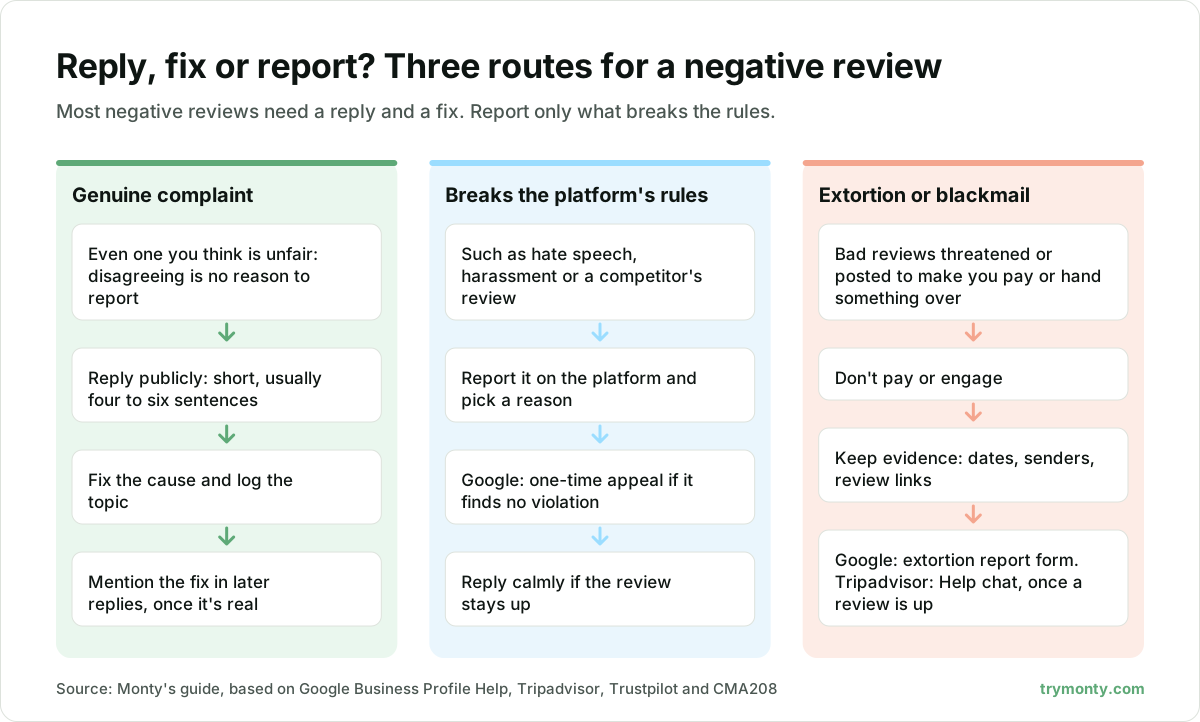
Sort each review into one of three piles.
| What you're looking at | What to do |
|---|---|
| A genuine complaint, even one you think is unfair | Reply publicly, then fix the cause |
| A review that breaks the platform's rules, such as hate speech or one from a competitor | Report it, and reply calmly if it stays up |
| Bad reviews threatened or posted to make you pay or hand something over | Don't pay or engage; keep the evidence and report it |
Google's own advice on negative reviews
Google publishes tips for replying to reviews. For negative reviews, it suggests you:
- protect the reviewer's privacy and never attack them personally
- check your records to understand what happened on their visit
- be honest: admit mistakes, but don't take the blame for things outside your control
- apologise where it's warranted, and show you understand how they feel
- sign the reply with your name or initials
- reply promptly
Google adds that a positive reply and follow-up may prompt an updated review; treat that as a bonus. It also advises short, polite replies with no deals or promotions.
As of September 2026, Google checks each reply against its content policies before it goes live, usually within 10 minutes but sometimes up to 30 days. The reviewer is told you've replied and can still change their review.
A 5-part reply structure
- Thank and acknowledge. Name the specific problem in your own words, without repeating personal details.
- Own it, or explain it. Apologise for what went wrong. If part of it was outside your control, say so briefly, without blaming the guest.
- Say what you've done. Mention only changes that have actually happened.
- Offer a direct line. Invite them to get in touch. On Google, you can ask them to email or phone you. On Tripadvisor, use a general venue inbox rather than a named person's email or mobile, because its response rules bar details that identify an individual. Keep any refund or goodwill gesture private, and never ask for the review to be changed or removed in return.
- Sign off. Name or initials, plus your role. Tripadvisor's rules bar personal information such as names, so initials are the safer choice there.
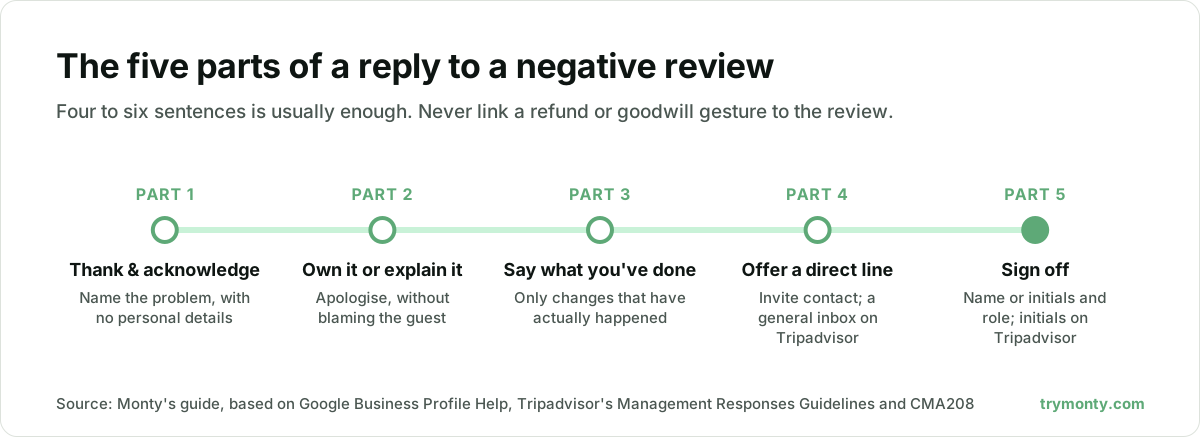
Four to six sentences is usually enough. In the examples, square brackets mark placeholders, and every detail you keep must be true.
Example: restaurant
The review says mains took a long time on a busy Saturday and arrived lukewarm.
Thank you for telling us about your evening. That wait for mains wasn't acceptable, and we're sorry your food wasn't hot when it reached the table. We were a chef down that night, which is our problem to solve, not yours. [What you've changed, e.g. We've since added an extra chef to the Saturday evening rota.] If you'd like to talk about your visit, please email us at [venue's general email address].
[Initials], General Manager
Example: hotel
The review says the air conditioning failed overnight, the guest wasn't moved until the morning, and the room above the bar was noisy.
Thank you for such clear feedback. You're right that the air conditioning in your room failed, and we're sorry it took until the morning to move you. Rooms above the bar do hear some music until it closes at 11pm, and we should have told you that. [What you've changed, e.g. The unit has been replaced, and we now mention the music when guests book those rooms.] If you'd like to discuss your stay, please contact us at [venue's general email address].
[Initials], Front Office Manager
Neither reply names the guest, quotes the review or a booking reference, or offers anything in public.
Things that get replies rejected or backfire
As of September 2026, Tripadvisor's rules bar responses that:
- accuse the reviewer of review fraud
- guess who the reviewer is, or include personal information such as names, addresses or phone numbers
- contain promotional content, offers of gifts, services or money, or irrelevant links
- threaten or coerce the reviewer, or try to suppress their review
- quote guest or third-party correspondence, or snippets of any traveller review, including the one you're answering
- comment on Tripadvisor's policies
- use lists or bullet points, or unreadable machine translation
Never offer something to get a review changed. The CMA gives this as an example of commissioning a fake review (CMA208, examples after paragraph 3.5):
Contacting a customer who has left a negative review and offering them a refund and/or a gift card if they change their review to remove the negative commentary (so that it is no longer reflective of their genuine experience).
CMA, Fake reviews guidance (CMA208)
Under the Digital Markets, Competition and Consumers Act 2024, commissioning a fake review, or one that hides an incentive, is a banned practice, and "commissioning" includes incentivising by any means. Google's Maps content policy also treats incentives for revising or removing a negative review as fake engagement.
The CMA also says traders should not threaten legal action to deter reviews, or make a dispute resolution offer depend on the guest not leaving a negative review (CMA208, paragraph 4.4). Fix the problem and refund if that's right, but never link it to the review.
Other habits that backfire: arguing point by point, pasting the same reply everywhere, blaming a named colleague, and replying while angry. Draft, wait, then get a second read.
Fake, abusive or extortion reviews: how reporting works
Google removes reviews that break its Maps content policy, including content not based on a real experience, conflicts of interest (such as reviews from current or former staff or competitors), off-topic rants, harassment, hate speech and personal information.
As of September 2026, to report a review, go to your Business Profile, select Read reviews, choose Report next to the review and pick a reason. Google says evaluation typically takes several days, and you can track it in the Reviews Management Tool. If Google finds no violation, you can submit a one-time appeal, which can cover up to 10 reviews.
Extortion has its own route. Google's extortion guidance describes a burst of 1-star and 2-star reviews followed by a demand for money, goods or services to remove them. Don't engage or pay. Gather evidence (screenshots showing the date, time and sender, and links to each review) and use Google's merchant extortion report form.
Tripadvisor
Tripadvisor's review guidelines treat it as blackmail when someone tries, in bad faith, to get something of value by threatening a negative review or promising to remove one. A guest who mentions a review while trying to get a real problem fixed, such as an incorrect order, is not blackmailing you.
To report blackmail, you need a specific review to report; Tripadvisor won't take reports in advance. Send the full, unedited correspondence, showing the sender's email address and the date, through the Help chat in your Management Center. As of September 2026, it says it can't investigate threats made verbally.
Report suspected competitor reviews from your Management Center too. Tripadvisor also removes reviews that only describe a disagreement with a stated policy, such as a no-dogs or no-refund rule, but keeps them if they describe a wider customer-service problem.
Trustpilot
Trustpilot lets you flag a review from your business account. Flag 5-star reviews for the same reasons as 1-star ones: it doesn't tolerate misuse of flagging, and misuse can lead to account suspension or profile warnings. If a review doesn't break its guidelines, reply with your side of the story.
Turning replies into operational fixes
A reply closes one conversation; a fix stops the next review. A routine you can start on Monday morning:
- Log every negative review. Record the date, platform, topic (wait times, noise, cleanliness) and what you did.
- Name an owner. One person owns replies, with a deputy for days off and a target such as two working days.
- Hold a weekly 15-minute check-in. Go through the log with your head chef, head housekeeper or bar manager, pick the most common topic and agree one change.
- Close the loop. Record each change, so future replies can mention it truthfully.
In hotels, asking for feedback during the stay can bring a problem to light while there's still time to fix it before check-out.
Where Monty fits
Monty's review inbox gathers Google, Tripadvisor and Trustpilot reviews and drafts a reply to each in your venue's tone. A person copies, checks and posts it; Monty never posts replies itself.
When a guest reports an issue through a QR code in the venue, the right person gets an SOS alert, which escalates if nobody acknowledges it.
Monty's AI reports include a weekly report email and track sentiment and topics over time.
This article is general information, not legal advice.

The team behind Monty, proactive reputation management for restaurants, hotels, bars and cafés.
How we write our articles